Corrections Department #1: Behind the Scenes of “Long Distance Call”
February 26, 2008
Last year Stewart Stanyard’s terrific new book Dimensions Behind the Twilight Zone opened up a new avenue into television history when it published a huge cache of never-before-seen production photos from fifty or so Twilight Zone segments. It was the first glimpse I’d ever had of many of the series’ soundstages, props, makeup effects, directors, and crew members. The text of the book wisely supplements rather than rehashes Marc Scott Zicree’s definitive Twilight Zone Companion, mainly through new interviews with surviving Zone participants who testify at greater length than they did for Zicree. (There’s an accompanying website with a lot of additional material, although the frame-based design quickly gave me a headache. The webmaster, “tzoneman,” is apparently Mr. Stanyard.) Between these two books, the website, and the extras in the DVD collections (which I’ve barely begun to dip into), The Twilight Zone has become the only important television show of its vintage for which we have exhaustive, multi-media documentation of its production.
I wouldn’t plug Dimensions Behind the Twilight Zone if I’d found many mistakes in it, but one thing did nag at me when I first read it. In this photo on page 229 from the taping of the segment “Long Distance Call” (the one where Lost in Space‘s Billy Mumy talks to his dead grandma on a toy phone), the caption identifies the bald man standing behind Mumy as the episode’s director, James Sheldon:

But Sheldon has become a friend since I approached him for an interview a couple of years ago, and this fellow in the picture didn’t look at all like James – even though, given the difference of over 45 years, who could really be sure? The uncertainty bothered me enough that I finally showed the book to James, who confirmed that he is not the man in the photo (and that, for the record, he still has all his own hair).
And then I became very glad that I had asked, because James pulled out one of his scrapbooks and showed me several photos from his private collection that were taken on that set on that same day in 1961. He has graciously allowed me to reproduce a couple of them to clarify matters. Here’s an image of Mumy standing behind the same table. James Sheldon is the man in the white shirt right in the center of the photo. (He couldn’t remember the name of the young man at right, standing directly behind Mumy, but thought he was the stage manager. “Long Distance Call,” you’ll remember, was one of the six videotaped episodes, which had technical crews more akin to live broadcasts than filmed series.)

Now I was curious as to the identity of the bald man in the original photo. If he wasn’t the director, who was he, and what was he saying to Mumy as the child actor dipped into his ice cream? I spotted him in the background of a few of James’s other stills. Here’s one in which James is giving direction to Lili Darvas, the legendary Hungarian stage actress (playing the grandmother).

The bald man is in the background, and seems to be directing his attention to the cabinet behind Ms. Darvas. It’s purely a guess, but I’d wager he’s the prop man. In that case, if I’m not mistaken, Mumy’s ice cream would also fall under his jurisdiction.
Of course, I present this small correction not as a knock against Mr. Stanyard’s fine research, but as a supplement to it. One of the ways in which the internet can be useful (and in which, unfortunately, outposts like Wikipedia and the Internet Movie Database often tend to be counterproductive) is as an arena for like-minded aficionados to share data and comment upon each other’s work. I’ll continue to use this blog periodically as a forum for this sort of exchange whenever the opportunity presents itself.
Update, 9/15/08: I haven’t purchased the reissued Season 1 Route 66 DVD set yet. But word on the street has it that while the second half has been redone in the correct 1.33:1 aspect ratio, the first fifteen episodes are still presented in the original mediocre 16mm transfers. I guess it’s up to the individual consumer to decide whether the glass is half full, or half empty. The complete Season 2 will be released on October 21. 7/14/09: The name of the Infinity Entertainment spokesman with whom I corresponded for this piece has been redacted at his request. He is no longer affiliated with Infinity.
Thus far I’ve refrained from turning this blog into a report on home video issues, even though I do keep tabs on them, because there are many other sites which perform that function ably. I’m also not fond of people who use their blogs as bully pulpits to harangue others less civilly than they would in person. But I’m suspending precedent and decorum today because I’m outraged by the offense that’s been committed against one of my favorite TV shows of the ’60s, Route 66.
Last week, a new collection of Route 66 episodes was released on DVD. This time, unlike in the preceding batch, every episode was shown in an incorrect aspect ratio that deletes a large swath of picture in a brutal effort to make the image conform to the dimensions of high definition TV sets. This has been tried by the studios before, when Warner Bros. released the first season of Kung Fu in faux widescreen. Outraged fans shamed the studio into correcting its mistake in subsequent volumes. But now it’s happening all over again, and to a TV classic far more important than Kung Fu.
Last October, Route 66 made its DVD debut in a package consisting of the series’ first fifteen episodes. I was overjoyed, because Route 66‘s combination of powerful writing (Stirling Silliphant’s beat-styled dialogue and existential, wanderlust-driven narratives introduced the counterculture into mainstream television), exceptional guest stars (New York-based casting gave unknown actors like Gene Hackman and Alan Alda key early roles), and location shooting in cities all over the U.S. made it a unique treasure. I’d seen all 116 episodes already, but I was delighted that a new, younger audience would have the opportunity to become conversant with this offbeat masterpiece.
Then reality set in. The first fifteen episodes were transferred to DVD mostly from sixteen-millimeter prints, rather than the far better looking tape masters that were broadcast on the Nick at Nite network in the late ’80s. The image quality wasn’t abysmal, but it was fuzzy and flat-looking enough to turn off many viewers who might be discovering the show for the first time; and there was the further problem that one of the first season’s strongest episodes, “A Fury Slinging Flame” (about nuclear paranoia), was cut by five minutes. All of this was especially frustrating that Route 66‘s “sister show,” Naked City, had received a partial DVD release on the Image label a few years earlier, and those transfers were jaw-droppingly gorgeous.
The problems seemed to stem from the fact that Sony, which owns Route 66 (along with the rest of the old Screen Gems TV library), had licensed the show out to an entity called Roxbury Entertainment which is, to put it kindly, inexperienced in the arena of home video. Roxbury is the operation of one Kirk Hallam, a producer of hack movies who optioned the property’s film rights and is currently trying to leverage a Route 66 remake out of development hell (which is exactly where it belongs). I guess DVD rights to the original series were part of the deal – the best part, some might say, but so far they’re being treated more like that piece of toilet paper that sticks to your shoe when you leave the bathroom.
Then, last week, Infinity Entertainment Group (Roxbury’s distribution partner) released Season 1, Volume 2, in a form that had many fans longing for the battered 16mm transfers from the first batch. Mr. Hallam had kept his promise to begin transferring the episodes from superior elements (what he referred to as “fine grain masters of film” in an interview), and indeed the level of clarity and detail was beautiful. But someone made a catastrophically wrong-headed decision: to “enhance” the image for widescreen televisions by cropping the shows from their original 1.33:1 (4:3) compositions to a 1.78:1 (16:9) framing. If you don’t understand the technical jargon, it means simply that 25% of the original image has been lopped off the top and bottom of the frame.
The unique circumstances of Route 66‘s production – it was the only major television show of its era to be filmed largely outside New York or Los Angeles – make it the worst possible candidate for this butchery. On the margins, the part that Infinity/Roxbury have seen fit to efface, is precisely where Route 66‘s cultural significance is located: in the architecture, the advertisements, the un-Hollywood faces of the local “background artists,” the uncluttered skylines that share the frame with Martin Milner and George Maharis.
Today Infinity issued a press release which crushed fans’ hopes that this was a mistake soon to be corrected, and went on to insult the intelligence of those who complained by claiming that there’s “some confusion in the marketplace about some of the technical aspects of this restoration process.” No, Infinity, we’re not the ones who are confused.
Then there’s a ludicrous attempt to put a positive spin on the mutilation of the image. Quoting the press release: “High Definition transfer which requires an update to the 16×9 aspect ratio for new HD TV Broadcast and future Digital Media delivery, i.e. Blu Ray DVD and HD Internet.” [Sic] Wrong: there are films (like Casablanca) with a 1.33:1 aspect ratio available in HD, and those have mostly been presented on hi-def DVD in a proper pillarboxed format. Cropping to 1.78:1 for HD is not a requirement, it’s a (bad) choice. More press release excuses: “During the film transfer, the post production house used a process called tilt and scan which allows a Telecine technician to examine each scene individually and center the frame on the action.” Terrific! I’ll enjoy watching these so much more knowing that the 25% of deleted picture was chosen judiciously by a technician fifty years removed from the original production rather than simply chopped off the top and bottom.
There’s plenty more to mock in that press release, but instead I’ll move on to report some clarifications that an Infinity spokesman was gracious enough to provide in an e-mail today. Regarding my most crucial questions, as to whether Roxbury would reissue the Season 1, Volume 2 set in 4:3 transfers and what aspect ratio future volumes (if any) would use, the spokesman would comment only that: “The state of future releases is unknown as of now. Discussions have been going on between IEG and Roxbury continually.”
When I pressed for details on whose idea it was to hack off part of the image for 16:9 formatting and why, the spokesman fingered a third party: “The post production house took it to widescreen without our knowledge. We received complaints about the picture quality on Volume 1, so we decided to invest a large sum of money to telecine the second volume for the ‘die hard fans.’ Ultimately, we caused a larger problem when it was taken to HD/Widescreen.” That represents a more forthright admission of error than anything in today’s press release.
But wait, what about this part of the press release: “While we tried to remain as true as possible to the original programming, our overall goal is to not only make the program available once again on television, but to optimize it for the next generation of broadcast and television standards.” Or the Infinity spokesman’s response when I asked who, exactly, made the decision to crop for widescreen, Infinity (which has distributed some exceedingly well-produced early TV packages, like Suspense and Man With a Camera) or Roxbury (which has no such track record). The spokesman wrote that “it was a joint agreement between the two parties. The decision was made without knowing that making it widescreen would ruin the cinematic qualities.” Well, okay, I’m with him on the “ruin” part, but now I’m confused. It seems to me that Infinity is trying to have it both ways: Oops, we messed up and Forced widescreen is good for you – learn to like it.
But I’m hoping it’s really true that this was just a telecine gaffe, because that means it can be fixed easily on future Route 66 DVDs – and because it would put to rest the speculation that Infinity/Roxbury opted cynically to sacrifice their DVD consumers in order to peddle new 16:9 Route 66 masters to hi-def TV channels whose viewers want their screen filled with image no matter what the cost. Just like in the good old pan-and-scan days of VHS. It’s maddening to have to combat this ignorance over and over again. Come on, people: remember Procrustes? That thing with the bed did not end well for him.
I do think there’s some sliver of hope that we’ll see subsequent seasons of Route 66 in their proper format (and they’d better be derived from those same pristine film elements). But that’s still not good enough for fans who would quite reasonably like to own the entire series in a watchable format. And though I strongly encourage Infinity to find a way to remaster and reissue their Season 1, Volume 2 set (and ideally the entire first season), I can’t imagine that such an endeavor would be economically feasible even for a much larger company. (That Kung Fu fix from Warners? Still waiting on it.)
To illustrate the impact of the cropping, here are a few image comparisons between the DVD and one of my bleary old tapes. They’re all from the first half of “The Opponent,” an episode from Season 1, Volume 2 selected more or less at random (except for the fact that the great Lois Nettleton has been on my mind lately). It’s a skid-row story in which the atmospheric ugliness of Youngstown, Ohio is as essential to the meaning as anything in the script.
Each of these may be a couple of frames off, but I hope they illustrate more eloquently than I have above why, to slip into consumer-ese, I’m giving this package the strongest possible DO NOT BUY advisory:


Expansive skylines on the open highway? Not so much any more:


Not nearly so much feeling of bustling Youngstown, Ohio in the claustrophobic DVD version:


A cool store sign . . . that would never catch your eye on the DVD:


The lovely Lois . . . with hat, and without:


Here’s Darren McGavin (giving a genuinely disturbing performance as a broken-down boxer) in a shot that loses all its seedy power when cropped:


Whither Otto Zempski? For those of you who bought the DVD, it turns out he’s at a “Pre-Fight Gala.” I’m thinking that Telecine technician scanned when he should’ve tilted on this one:


Obituary: Harry Kleiner (1915-2007)
February 11, 2008
The Writers Guild of America today confirmed the death of the screen and television writer Harry Kleiner on October 17.
Kleiner, born in Russia and raised in Philadelphia, contributed to a raft of well-known films over a span of more than four decades. His first screenplay, a solo effort (adapting Marty Holland’s novel), was for Fallen Angel (1945), a moody film noir that was Otto Preminger’s follow-up in that genre to his celebrated Laura. Kleiner’s next work was the bland 1948 policier The Street With No Name (remade, with considerably more pep, by Sam Fuller as House of Bamboo). From there Kleiner moved on to write a number of studio A pictures including Lewis Milestone’s Kangaroo (1952), William Dieterle’s Salome (1953), Curtis Bernhardt’s Miss Sadie Thompson (1953), Preminger’s Carmen Jones (1954), Rudolph Mate’s western The Violent Men (1955), and two at Warner Bros. for Vincent Sherman, the epic Ice Palace (1960) and A Fever in the Blood (1961). He also worked without credit on William Wyler’s Friendly Persuasion (1956). Following an interlude in television, Kleiner worked on Richard Fleischer’s Fantastic Voyage (1966) and then Bullitt (1968) and Le Mans (1971) for Steve McQueen. His final credits – the last awarded at an ageism-defying 73 – were on two action pictures in collaboration with director Walter Hill, Extreme Prejudice (1987) and Red Heat (1988). Kleiner was nominated for two WGA Awards and won an Edgar for Bullitt.
Kleiner’s television credits were selective but noteworthy. Roy Huggins, who produced A Fever in the Blood, was an advocate for luring veteran screenwriters into television, and he engaged Kleiner to write four episodes of the worthwhile TV version of Bus Stop (1960-61). In the same season Kleiner wrote at least two teleplays for the Untouchables knockoff Target: The Corrupters. In 1962, when Huggins moved from the cancelled Bus Stop at Fox to produce Universal’s new ninety-minute western The Virginian, Kleiner followed and wrote all or part of six segments. None of those, as it happens, were very good: Kleiner seems to have fared better working with strong feature directors, or adapting literary material, than in the fast-paced world of crafting original stories for television.
The Guild also confirmed my suspicion that Kleiner also wrote under the name “Harold Clements” (note the similarity in both initial consonants). Several internet sources indicate that Kleiner’s credit on a 1964 segment of the Chrysler Theatre, “The Faceless Man,” morphed into one for Clements after the show (an unsold pilot, I think) was released theatrically in 1968 under the title The Counterfeit Killer. The Counterfeit Killer was padded out with some reshoots scripted by a young Steven Bochco (whose first screenwriting job was this curious one of expanding old anthology episodes into low-budget movies for Universal). It’s understandable that Kleiner would want to take his name off that mess, although I’m unclear as to why he used the pseudonym on six full or partial Checkmate teleplays between 1960-1961. Most likely, Kleiner was under exclusive contract to another studio (presumably Warners) at the time and sought to conceal his moonlighting. (Pulp enthusiasts take note: One of those Checkmates was a rewrite of a Leigh Brackett script, another a polish of a William P. McGivern teleplay.) None of the Clements Checkmate scripts strikes me as very impressive either, apart from the final one, “Voyage Into Fear,” a final draft of a story & teleplay by the underrated TV western writer Edmund Morris.
I first got interested in Harry Kleiner after reading A Very Dangerous Citizen, Paul Buhle and Dave Wagner’s biography of the blacklisted writer-director Abraham Polonsky. In it, Buhle and Wagner (perhaps respecting their subject’s legendary reluctance to confirm his under-the-table work, or else simply speculating) hinted provocatively that Polonsky made uncredited contributions to the screenplays for both Preminger’s Carmen Jones (1954) and Robert Aldrich’s The Garment Jungle (1957). (Aldrich was replaced by Vincent Sherman, who received sole credit.) The authors observed that the directors of those films shared a sympathy for leftist politics (and victims of the blacklist), but I noted another connection: both screenplays were credited entirely to Harry Kleiner. An unlikely coincidence, or had Kleiner perhaps worked as a front for Polonsky on two important features?
I decided it might be worthwhile to ask him, and to collect whatever stories Kleiner could tell about his TV work on the way, but sadly he never responded to any of my inquiries via the Writers Guild. My hunch is that he was ill the whole time. His last residence was apparently far from Hollywood, in the Chicago area, which may help explain why no one noticed the passing of this major screenwriter . . . until now.
The Day the Running Finally Stopped: Barry Morse (1918-2008)
February 6, 2008
At the risk of letting this blog become just an honor roll of the dead (never my intention), I have to chime in with a few words about the inimitable Barry Morse, who passed away this past Saturday, February 2.
Morse remains beloved by TV fans because of his role on The Fugitive, one of the finest dramas on the tube during the ’60s. (Less discriminating TV viewers may remember him from his regular role on Space: 1999.) Morse played the primary pursuer and tormentor to David Janssen’s innocent death-row escapee Dr. Richard Kimble. Every episode of The Fugitive saw Kimble ducking around corners or thumbing for the freeway to elude the local fuzz in whatever backwater burg he found himself hiding in. But the really tense episodes, the ones where the producers (Alan Armer and later Wilton Schiller) wanted to up the stakes a notch, put Morse’s Lt. Philip Gerard on the case.
Gerard was the hometown police detective who busted Kimble in the first place, and who was handcuffed to the alleged wife-killer during the train wreck that set him free. Though he had no special jurisdiction over recapturing Kimble, Gerard would drop everything and hop on a plane anytime word of a Kimble sighting came in over the teletype. When Dr. Kimble saw Gerard sniffing around on his trail, he knew he was in really deep shit that week.
The Fugitive was a show I gorged myself on during my teens, and it was my first real exposure to Morse. Since then I’ve seen a lot more of his early television work, and what I’ll bet a lot of people don’t realize is how much of a departure the character of Gerard was for Morse, at least at that time.
Catch one of Morse’s pre-Fugitive TV roles, and more than likely you’re in for a heavy meal of ham. Most of the time, Morse went big. Maybe because Morse was British by birth and Canadian by inclination – he resettled in Toronto in 1951 and did so much live TV they called him “the CBC test pattern” – American television didn’t know quite what to do with him. For much of the early sixties, he was typed within a pretty narrow specialty: bohemian artists and snooty critics.
Morse is pretty hard to take as Fitzgerald Fortune, a theatre critic who tortures people with a haunted player piano, in “A Piano in the House,” one of those generic Twilight Zones in which some mean little man yaps for the whole half-hour about how he’s going to avenge the gigantic chip on his shoulder. He’s even more insufferable in “Who’ll Dig the Graves,” a Defenders in which he chomps the scenery as an alcoholic, junkie beatnik poet. Classically trained (at RADA), Morse was a natural choice whenever some showoffy writer had dressed up a thesaurus as a character, as in the Nurses episode “A Private Room.” Somehow, in the execution of Morse’s performance as Oliver Norton Bell, a misanthropic failed scholar dying of leukemia, the actor and his director, Don Richardson, came to the ill-advised conclusion that Bell’s each and every line should be barked at full volume.
Morse’s other early specialty was accents: English, German (as a defector scientist in another Nurses, “Escape Route”), or simply nondescript Euro-generic. I think it’s supposed to be French in the maladroit Alfred Hitchcock Hour, “A Tangled Web,” in which a toupeed Morse attempts a flamboyant hairdresser whose, er, business partner is Robert Redford. One element of the say-what? twist ending is that Morse’s character isn’t as gay as he’s coded to be; in any case, it’s the nadir of Morse’s over-the-top eccentric period.
If you know Morse only as Philip Gerard, it’s hard to imagine him in these roles. But Stirling Silliphant’s earnestly Freudian Naked City, which used Morse thrice between 1961-62, began to see him in the same way The Fugitive would. In “Portrait of a Painter,” about William Shatner’s homicidal non-representational artist, Morse whirls through in a cameo as an art dealer called in by the cops (with a straight face) to scrutinize Shatner’s canvases and advise as to whether he’s crackers or not. Later Morse starred in Abram S. Ginnes’ complex “Memory of a Red Trolley Car,” as a chemistry professor whose exposure to a deadly poison sends him on a journey of self-exploration, confronting mother, mistress, and estranged wife. It was a difficult role, requiring Morse to verbalize a lot of emotions that would logically have remained subtextual, and he executed it with simplicity and integrity. (It helped that the script incorporated Morse’s own background as an Americanized Englishman.) In both segments Morse got a lot of mileage out of the same thick-rimmed glasses that would become an essential prop for Lt. Gerard.
Gerard: As I write this, I’m watching “Never Wave Goodbye” again. It’s a two-parter, the first Fugitive to give Gerard a personal story parallel to Kimble’s. Look at Gerard’s opening scene, where he gets a lead on a one-armed ex-con (not the right one, it turns out) in L.A. and soft-soaps his boss (Paul Birch as Captain Carpenter) into letting him go have a look. Morse plays it down to practically nothing, all soft-spoken and reasonable-sounding. He had no way of knowing the series would last for four years, but he leaves himself room to build to the fever pitch Gerard would hit before the end. “Never Wave” gives him the character’s first crescendo, the first time he squares his jaw and bails on a fishing trip with his son to go chase Kimble; the first time he barges into some out-of-town police station and starts barking orders at slack-jawed local cops. The first glimpse of Supercop. Or, no: more. Worse.
Because, here’s the point I wanted to make about Barry Morse. I think he may deserve more credit than anybody else for the element of The Fugitive that’s truly subversive: the anti-police subtext that made it a counterculture totem. Morse’s Gerard represented American television’s first sustained presentation of the police as essentially maleficent. A lot has been made of how the network oafs all turned down Roy Huggins’ pitch for the show because (no matter how slowly Huggins talked as he explained that Kimble was innocent) they didn’t get how a criminal could be a hero and a cop could be the bad guy. Fine, but that idea was coming anyhow, with the Watts riots and Kent State only a few years away from the evening news. It was Morse who made the ugliness of the police visceral, with his clamp-jawed sneer and his thousand-yard stare. Morse underlined the fact that it was personal for Gerard. He wasn’t a dutiful flatfoot. He was an authority figure whose omnipotence had been flouted, and he wanted payback.
To put Morse’s contribution in perspective, just consider how much tamer The Fugitive would have been with a stolid, conventional cop actor – like, say Tige Andrews, The Mod Squad‘s Captain Greer – in the Gerard role, someone who would’ve played it like he was the hero. Gerard actually had lines like that all the time – modest-sounding dialogue about how he was just a tool of the law, and it wasn’t his problem whether Kimble was guilty or innocent – but the way Morse said them, you knew he was full of it. The sixties were when we first realized that some cops beat people up just because they got off on it; and that often the police function, not to punish the guilty or protect the innocent, but to suppress those who challenge the status quo. (Gerard’s catechism was “The law said Kimble is guilty. I enforce the law.”) On its face The Fugitive was never this topical – not even close – but Morse’s performance smuggled the idea in.
“Never Wave Goodbye” was also the first episode in which Gerard went rogue (he jumped ship in a little rubber raft after a coast guard skipper wouldn’t continue pursuing Kimble in a thick fog), and from then on you can pick any episode and find Morse personifying some new wrinkle in martial arrogance. A few weeks later, in the great “Nightmare at Northoak,” the one where Gerard is even haunting Kimble in his dreams, Gerard crashes town to pick up the fugitive after he saves some kids from a burning bus. Kimble is the local hero and the small town folk all loathe the condescending Lt. Gerard. Morse plays it totally oblivious. “Now, look, son, you have nothing to be ashamed of,” he says to the little boy who got Kimble captured, just oozing smugness.
As the show went on, Morse built on this notion, turning the character more tight-lipped and tightly-wound, more short-tempered and monomaniacal. Stephen King wrote about it in his intro to Ed Robertson’s Fugitive companion book, how Morse made it possible to track Gerard’s progression, in King’s words, “further and further into freako land.” The idea was always there in the premise – The Fugitive was what TV writers used to call a “haircut” of Les Miserables – but I’m convinced that without an actor as intelligent as Morse in the role, someone to recognize and emphasize the connection to Hugo’s Javert, the show’s anti-authoritarian strain would have evaporated. No one else could have built it in as subtly, and who would have fought to jam it in at the surface? Not Quinn Martin, and not ABC.
Even Morse’s physicality was a kind of innovation. He didn’t look like any movie or TV cop that came before him. With his small frame and slighly outsized head, his receding hairline (with the odd, birdlike tufts in the back), Morse seemed more like an accountant or an academic than a tough guy. And the actor cultivated that look. Morse told Ed Robertson that, during the shooting of the Fugitive pilot, he chucked the cliche wardrobe (trenchcoat and fedora) that the costumers dug up for Gerard behind a bush and stuck to off-the-rack suits for the rest of the series. Gerard was an unprepossessing figure, a quotidian cop, and that tied into the show’s concept of law enforcement as a malevolent force cloaked in a bland guise. The Fugitive took care to identify Gerard as a quintessentially American character, a suburban dad and wife, and that mythology became part of the nightmare. Gerard takes his son hunting, and the kid runs into Kimble and ends up bonding with him instead (in “Nemesis”); later Gerard’s wife, explicitly cracking up because of his obsession, leaves him and almost falls into Kimble’s arms too (in “Landscape With Running Figures”). And Morse plays this baroque material with a stiff upper lip: his Gerard, his übercop, doesn’t have the imagination to do anything but nurse his wounded pride and wait for his day of vengeance.
Which never comes. It’s a tribute to Morse that he hovered over The Fugitive as an ominous presence even though he only appeared in about a third of the 120 episodes (plus the weekly opening title sequence). He was sufficiently formidable to personify the relentless presence of law enforcement even as the producers kept him off-screen enough so that Gerard didn’t become a joke, always tripping over Kimble just as Gilligan was always almost getting off the island. The big payoff in the final episode was not Kimble’s exoneration, which didn’t even happen on-screen, but the final encounter between Janssen and Morse. An anti-climax? You be the judge.
In the late nineties I knew a video entrepreneur who recorded Morse introducing some Fugitive episodes for a VHS release. He told me that Morse (by all accounts a thoroughly nice man) was not well and despondent over the loss of his beloved wife, so I was surprised that he lived as long as he did. He used his final years well, completing an autobiography that I hear is worthwhile and a cute video promo for it.
If there’s an afterlife for TV characters, then Richard Kimble’s just got a lot more complicated. He’ll be looking over his shoulder again after a long breather . . . but then again, he’s got some company for the long, lonely journey now.
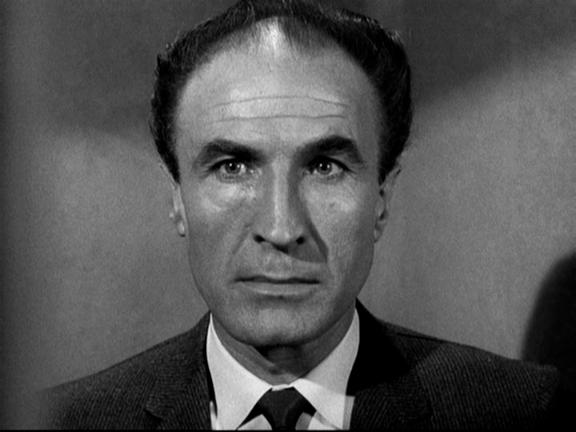
That thousand yard stare (from “Nightmare at Northoak”).
2007 TV Necrology
February 1, 2008
Writers
Jan 1: A. I. Bezzerides, co-creator of Big Valley.
Jan 9: Laurence Heath, writer/producer for Mission: Impossible and The Magician.
Jan 27: Bob Carroll, Jr., I Love Lucy legend.
Jan 30: Sidney Sheldon, creator of I Dream of Genie.
Feb 9: Elliott Baker, live TV writer (U.S. Steel Hour, Way Out).
Mar 18: Jack B. Sowards, specialist in late-period westerns (Bonanza, High Chaparral).
Apr 6: Stan Daniels, Mary Tyler Moore Show writer and co-creator of Taxi.
Apr 9: A. J. Carothers, story editor (Studio One) and writer (My Three Sons).
Apr 13: Gail Ingram, live TV vet (Mama, Big Story) and My Three Sons rewrite guru.
May 6: Cynthia Lindsay, who wrote some My Three Sons and Family Affairs.
Jun 16: Wanda Duncan, who wrote a lot of Irwin Allen shows with her husband Bob.
Jun 17: Robert Vincent Wright, writer of many Mavericks and Bonanzas.
Jun 21: Suzanne Holland, ’60s soap opera writer.
Jun 23: Glenn Wolfe, who wrote two Perry Masons with Sol Stein.
Jul 27: David Shaw, prolific writer for nearly every major live dramatic anthology and story editor on The Defenders.
Aug 8: Melville Shavelson, screenwriter who produced My World and Welcome to It.
Aug 17: Max Hodge, industrial show writer who turned to TV (Girl From UNCLE, Batman).
Aug 25: Jim Carlson, Laugh-In writer turned’70s action scribe (Battlestar Galactica).
Sep 6: Sidney Ellis, action journeyman (Bonanza, Voyage to the Bottom of the Sea).
Sep 19: Robert Sabaroff, Star Trek writer and Then Came Bronson producer.
Oct 17: Harry Kleiner, versatile drama/action writer (Bus Stop, Checkmate, The Virginian).
Oct 18: J. T. Gollard, who co-wrote one episode of The Fugitive.
Nov 7: George W. George, prolific action writer (The Rifleman, Adventures in Paradise) with his wife Judy.
Nov 9: Francine Carroll, creator of Amy Prentiss.
Nov 12: Ira Levin, novelist/playwright who began as a busy live TV writer (Lights Out, U.S. Steel Hour).
Nov 18: Hollis Alpert, film critic who co-wrote one Johnny Staccato.
Nov 26: Mel Tolkin, Your Show of Shows head writer.
Dec 14: Jack Gross, Jr., sitcom writer (Gilligan’s Island).
Dec 19: James Costigan, Hallmark Hall of Fame mainstay and Emmy winner for TV movies.
Dec 31: Bill Idelson, one of the major Andy Griffith Show contributors.
Directors
Feb 18: Jack Wood, Emmy-winning soap opera director (All My Children).
Mar 3: Sutton Roley, action director (Combat, Mannix) renowned for his visual flair.
Mar 15: Stuart Rosenberg, the top dramatic TV director in the early ’60s (Naked City, The Defenders, Chrysler Theater).
May 6: Curtis Harrington, indie horror filmmaker who directed TV movies and episodes (Charlie’s Angels) in the ’70s.
May 11: Norman Frank, live TV director/producer (The Jonathan Winters Show, Wide Wide World).
Jun 11: Bill Glenn, TV documentary director who became big in soaps (Young and the Restless).
Jun 26: Ron Weyman, top CBC director (Wojeck) who did a few US shows (Adventures in Paradise).
Aug 11: Richard Compton, ex-actor turned action director (Miami Vice).
Aug 27: Richard Heffron, ’70s film director who did the pilots for Toma and The Rockford Files.
Oct 26: Bernard L. Kowalski, prolific A-list director (Rawhide, Columbo) who launched Mission: Impossible.
Nov 11: Delbert Mann, Philco Television Playhouse staffer famous for “Marty.”
Dec 21: John McPherson, cinematographer (an Emmy winner for Amazing Stories) and director (Incredible Hulk, Alien Nation).
Actors
Jan 8: Yvonne DeCarlo, Lily Munster.
Jan 13: Larkin Ford (aka Will West), purported last survivor of live “Twelve Angry Men” cast.
Jan 16: Ron Carey, annoying Barney Miller regular.
Jan 27: Tige Andrews, Detectives supporting cop and Mod Squad‘s Captain Greer.
Jan 31: Lee Bergere, character actor who played Abe Lincoln in a Star Trek.
Feb 4: Barbara McNair, black singer and ’60s ingenue who had her own variety show.
Feb 14: Lee Patterson, top-billed star of Surfside 6 (reported in the media some eight months after his death).
Feb 15: Walker Edmiston, voice actor also in many authority-figure bits in the ’60s.
Feb 19: Janet Blair, ’40s movie star turned live TV ingenue.
Feb 24: Bruce Bennett, ex-Tarzan who guest-starred on a lot of ’50s and ’60s shows.
Mar 1: Eddie Firestone, diminutive supporting player in hundreds of TV episodes.
Mar 11: Betty Hutton, ’40s movie star who had an eponymous sitcom.
Mar 15: Alice Backes, tall small-part actress, a secretary or spinster aunt in many sitcoms.
Mar 20: John P. Ryan, eccentric character actor, often a villain or cop in ’70s TV.
Mar 21: John Zaccaro, early ’60s bit player.
Mar 22: Angus Duncan, bit actor/second lead active on TV from the ’60s through the ’90s.
Apr 1: Salem Ludwig, blacklisted New York character actor, a recurring D.A. on The Defenders.
Apr 2: Paul Reed, comic actor, the boss on The Cara Williams Show, recurring on Car 54.
Apr 7: Barry Nelson, square-faced star of ’50s live anthologies and My Favorite Husband.
Apr 11: Roscoe Lee Browne, imposing black character actor, recurring on Soap.
Apr 19: Bob Miles, frequent bit player (and Michael Landon’s stunt double) on Bonanza.
Apr 24: Roy Jenson, sneering supporting villain in many westerns and QM shows.
Apr 28: Dabbs Greer, resident clergyman on Little House on the Prairie and Picket Fences, a quintessential small-part character actor at his best in infrequent heavy roles.
Apr 29: Andre Philippe, Cricket’s bandleader on Hawaiian Eye and a teacher on Mr. Novak.
Apr 30: Tom Poston, Steve Allen regular and Newhart sidekick.
May 6: Maurice Marsac, French-accented bit actor who played many a headwaiter.
May 7: Shirl Conway, star of The Nurses. Arch Whiting, one of the crewmen on Voyage to the Bottom of the Sea.
May 9: Beau Van Den Ecker, stuntman/bit player on Combat and Hawaii Five-O.
May 27: Gretchen Wyler, stage actress in an occasional TV guest role.
Jun 11: Mala Powers, film ingenue turned guest star on many Perry Masons and Warner Bros. westerns & private eye shows.
Jun 16: Joe di Reda, busy bit actor.
Jun 21: Carlos Romero, Mexican supporting player with a devilish grin.
Jul 9: Charles Lane, TV’s oldest old man and Petticoat Junction‘s Homer Bedloe.
Jul 11: Rod Lauren, ’60s juvenile lead guest star and real-life murder suspect/suicide.
Jul 12: Maury Hill, veteran bit player from live TV (Space Patrol).
Jul 17: Bart Burns, actual last survivor of live “Twelve Angry Men” cast.
Jul 19: Laura Devon, beautiful ’60s blonde, an underutilized ingenue and member of the Richard Boone Show repertory.
Aug 3: James Callahan, perpetual guest star and recurring Dr. Kildare intern.
Aug 21: Terri Messina, cute bit player in late ’60s shows.
Aug 24: Bill Catching, veteran stunt man who spoke a line or two in many ’60s shows.
Aug 28: Miyoshi Umeki, ethnic-stereotype housekeeper on The Courtship of Eddie’s Father.
Sep 3: Steve Ryan, Tige Andrews lookalike and Crime Story supporting cop.
Sep 4: Michael Evans, British-born bit player.
Sep 6: Percy Rodrigues, black lead guest actor of the ’60s and ’70s.
Sep 10: Jane Wyman, ’40s movie star who hosted the Fireside Theatre.
Sep 15: Brett Somers, Match Game panelist and TV guest star (Defenders, Odd Couple).
Sep 18: Sallie Brophy, busy ’50s and early ’60s supporting actress.
Sep 21: Alice Ghostley, comic character actress who was one of Bewitched‘s witches.
Oct 2: George Grizzard, essential everyman actor of the ’60s, in important TV roles from The Twilight Zone to Law and Order.
Oct 9: Carol Bruce, WKRP in Cincinnati‘s Mama Carlson.
Oct 12: Lonny Chapman, hoarse-voiced character actor, ubiquitous on The Defenders, ’50s live anthologies, cop shows & westerns.
Oct 14: Sigrid Valdis, Colonel Klink’s sexy secretary on Hogan’s Heroes.
Oct 17: Joey Bishop, star of an eponymous ’60s sitcom.
Oct 21: Vic Ramos, bit actor in ’60s New York shows and later a major casting director.
Oct 25: Lyn Statten, small-part actress in ’50s and early ’60s TV shows.
Oct 30: Robert Goulet, the star of Blue Light.
Nov 10: Laraine Day, ’40s movie star turned frequent TV guest star (Hitchcock, Wagon Train).
Nov 14: Michael Blodgett, who played a lot of hippies in late ’60s shows. Ronnie Burns, briefly a juvenile lead in the ’50s and played himself on father George’s series.
Nov 19: Dick Wilson, sitcom bit player made famous by some TV ads.
Nov 28: Jeanne Bates, Ben Casey‘s Nurse Wills and a familiar supporting player.
Dec 5: Joe Brooks, F Troop supporting player.
Dec 23: Michael Walker, sixties juvenile lead (Perry Mason, Ironside).
Other Creative People
Jan 1: Howard Kunin, film editor (Gidget, Cannon).
Jan 4: Richard Belding, head film editor for Universal TV during the late ’60s. Steve Krantz, network exec and producer.
Jan 27: Claude Binyon Jr., assistant director on The Outer Limits and Get Smart.
Jan 30: Karl Messerschmidt, longtime technical director at NBC (The Dean Martin Show).
Feb 6: Frankie Laine, sang the Rawhide theme and appeared in a few ’60s shows.
Feb 27: Meryl Abeles (O’Loughlin), casting director (Outer Limits, The Fugitive) and casting exec for MTM Productions.
Mar 4: Robert Prince, top ’70s composer of incidental scores (Mannix, Night Gallery, Name of the Game).
Apr 1: Tom Moore, network president who dumbed down ABC from 1962-1969.
Apr 23: Bob Moore, film editor (Dobie Gillis, I Spy, Good Morning World).
May 14: William W. Spencer, director of photography many shows, especially for QM (12 O’Clock High, The FBI).
May 21: Bud Molin, film editor (I Love Lucy, The Dick Van Dyke Show, I Spy).
May 25: Benjamin J. Kasazkow, art director on The Defenders, Hawk, and NYPD.
May 26: George Greeley, composer (My Living Doll, the My Favorite Martian theme).
Jun 2: Leroy Coleman, MGM art director for Mr. Novak, Cain’s Hundred, etc.
Jun 10: Ben Lane, Columbia makeup dept. head overseeing Bewitched, The Monkees, etc.
Jun 17: Ed Friendly, network exec turned producer (Laugh-In, Backstairs at the White House).
Jun 25: Carmen Dirigo, hair stylist for The Andy Griffith Show and Petticoat Junction.
Jun 30: Will Schaefer, composer of incidental scores for I Dream of Jeannie and other sitcoms.
Jul 27: William Tuttle, created some famous makeup designs for The Twilight Zone.
Jul 29: Tom Snyder, old-school talk show host.
Aug 12: Merv Griffin, game show pioneer & talk show host.
Sep 8: James McAdams, producer at Universal (The Virginian, Kojak).
Sep 28: Martin Manulis, legendary live TV producer (Playhouse 90).
Oct 23: Robert F. O’Neill, associate producer on Dr. Kildare and Columbo.
Nov 13: Monty Westmore, Ozzie and Harriet makeup man.
Dec 3: Gary Shaffer, casting director for The Courtship of Eddie’s Father and Medical Center.
 The Classic TV History Blog


